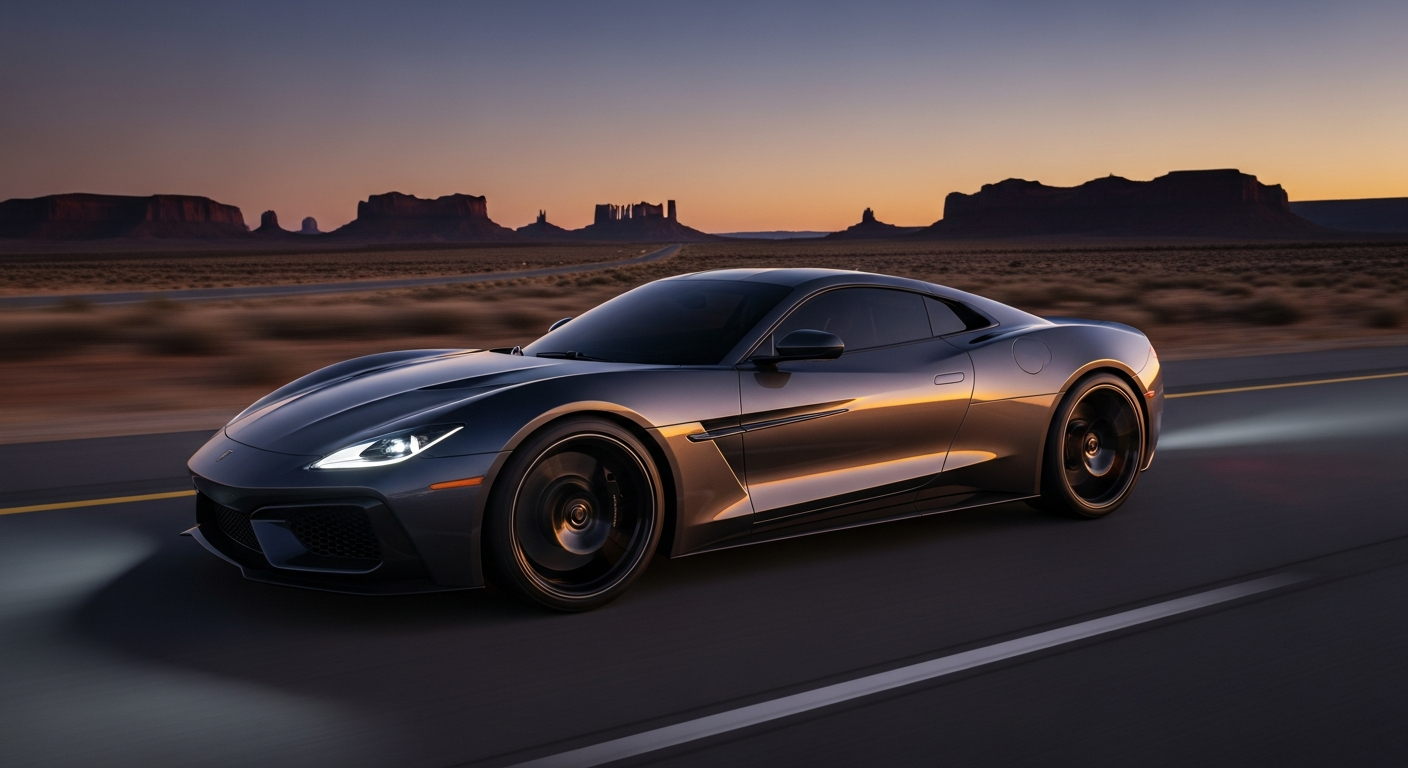
Cars are the hardest hero asset in commercial CGI. Skin and hair come close, but cars carry one extra burden: every viewer in the world sees them in real sunlight every single day. Your brain has spent decades building an infallible model of how sheet metal reflects an overcast sky. If your clearcoat is off by 0.02, someone in the client room will tilt their head and say, ‘It feels like a toy.’
THE SEVEN THINGS TO NAIL BEFORE ANYTHING ELSE
- →1. Orange peel roughness map on clearcoat: factory paint is never optically flat.
- →2. Micro-flake anisotropy: metallic basecoats reflect differently depending on viewing angle.
- →3. Panel gap ambient occlusion depth: real seams have light leak and bevel variation.
- →4. Tire rubber subsurface scattering: synthetic rubber absorbs light, never pure diffuse.
- →5. Glass tint gradient: automotive laminate has subtle UV filtering green/blue tint.
- →6. Headlamp interior caustics: reflector geometry needs real raytraced refraction.
- →7. Brake disc directional anisotropy: lathe-turned rotors show concentric micro-scratches.
Get those right and the car will sell itself in any environment. Get them wrong and no amount of compositing will save the shot.